When You or a Loved One Needs Help: Taking the First Step Can Bring Peace of Mind
The holidays can be joyful, but also sad or anxious. Those who have family and/or good friends can enjoy spending time with their loved ones, but sometimes seeing someone after time spent apart makes you realize that worrisome changes are occurring, and that your family member or friend needs help. Or perhaps you realize that you are the one who would benefit from some assistance.
The problem is that many people don’t know where to start. What is needed: a aide, a daily money manager, a geriatric care manager, an eldercare attorney, or something else? Who should you call? It can feel overwhelming and depressing.
The answer is usually closer than you think, and surprisingly easy to do. The best first step is to call a professional who deals with the numerous aspects of aging, and start a conversation.
You want to ensure that you have considered the best possible choices available to you. The reason we feel it is best to call an Eldercare or Elder Law attorney (the terms are used interchangeably), is that they know the legal and financial aspects of long-term care planning, and they have connections with many other service and care providers who can help with other aspects of aging.
At our firm, during the initial phone call we will review some of your basic information, and we will recommend the next steps for you. Often the recommended next step would be a consultation with one of our attorneys, but that is not appropriate or necessary in every situation. If indicated, we can and do refer people to other organizations that are better able assist them. We are happy to begin the process of guiding you to the people who are best suited to serving your needs and objectives.
After your phone call, an initial consultation at our firm will involve an in-depth review of your health, family, and financial situation, as well as your personal objectives. All these aspects of your life feed into the plan an Eldercare attorney will recommend.
The consultation will address the available legal options, but the discussion often reveals additional needs and indicates other services that could be helpful to you. If you need assistance with other aspects of aging, we can recommend excellent professionals in other fields as well.
For example, if you need an aide in the home, many of the home care agencies you might contact accept private pay only. While we know and often recommend excellent private pay agencies, you may also want to consider using an agency that accepts Medicaid payment as well as private pay, if you are considering seeking Medicaid benefits.
If you need another type of service provider, such as a daily money manager or financial advisor, we are happy to refer you to other professionals we know and trust. We are not paid for referrals, nor do we pay for them. Everyone’s goal is simply to give excellent service.
This procedure – in-depth consultation, determining your needs and objectives, recommending legal steps and referring other professionals whose services you may need – is how we operate every day. Not all Elder Law firms work this way.
Feeling that the first call you make will open the door to finding a plan that works for you, and will also provide you with access to other professionals you can trust, can bring tremendous peace of mind. Call today, then you can relax and actually enjoy the holidays!
Five reasons why a Medicaid Asset Protection Trust (“MAPT”) is an essential planning strategy for many
More so in New York than in any other state, Medicaid is not “just for poor people.” Medicaid serves millions of people in New York, many of whom own homes and have investments and savings. They and their families would be devastated financially without Medicaid assistance for their long-term care needs. Once someone needs long-term care, it quickly becomes clear that money is pouring out of their bank account with terrifying rapidity, and with no end in sight.
Some mistakenly believe that Medicare will cover their needs. It will not. Health or medical insurance does not cover long-term care. Only long-term care insurance will cover long-term care and very few people have a policy. And for those who have a policy, often the coverage and benefits are inadequate.
Most people will come face to face with the shocking fact that even a modest amount of home care could cost $100,000 per year, or that assisted living or nursing home care could cost $150,000 to $200,000 per year. Multiply these numbers by 3, 4, or 10 years of increasing long-term care needs. Most people don’t have this kind of money to spend without rapidly depleting their life’s savings and jeopardizing the ownership of their home. And, of course, the fees for these services rise every year.
Fortunately, residents of New York can take steps to avoid financial disaster. One of the most effective strategies is the Medicaid Asset Protection Trust (“MAPT”). Here are five reasons why the MAPT is so valuable and effective.
1. A Medicaid Asset Protection Trust will facilitate eligibility for Medicaid
In order to be Medicaid eligible, you can have only a very limited amount of assets in your name. When you create and fund a MAPT, think of the Trust as another person. The trust assets no longer belong to you and cannot be counted by Medicaid in determining your eligibility. Once the amount of your assets is below the eligibility level, you can quickly obtain Community Medicaid benefits, including home care or assisted living care.
For Community Medicaid, there is an income limit, but your income is NOT a factor in determining Medicaid eligibility. In fact, if your Medicaid Asset Protection Trust contains investments that produce income, e.g., interest or dividends, you can continue to receive all of the investment income even though you no longer own the underlying assets. Receipt of this income will not affect your eligibility for Medicaid. However, you may need to protect your so-called “surplus income” in a different kind of trust, the Pooled Income Trust.
While creating and funding a MAPT will allow you to quickly attain eligibility for Community Medicaid, the path to Medicaid Nursing Home eligibility may take more time due to the five-year “look back.”
2. A Medicaid Asset Protection Trust helps your money last longer
The goal of the Medicaid Asset Protection Trust is to protect your assets and make them last as long as possible, so that you (and your spouse and family) can maintain a comfortable lifestyle. You may have a mortgage or other financial obligations or want to modify your home to make it safer and easier to live in as you age, or need to replace appliances, the roof, or fix the plumbing.
While the assets in the MAPT are no longer subject to your control, the Trustee can be given the authority to distribute trust assets to others, typically to a Co-Trustee or other family members. They can use the assets distributed to them to pay for anything that you may need or want. When you choose the Trustee(s) and beneficiaries of your Asset Protection Trust, you will want to keep this possibility in mind.
Creating an MAPT is not a “loophole” or an effort to “hide” your money. Protecting your money and property and attaining eligibility for Medicaid are not improper or unethical goals – they are an optimal outcome. Medicaid is very well aware of the use of the Medicaid Asset Protection Trust, and will review your trust in the application process. Elder Law attorneys have been using this strategy for years.
3. Placing your assets in an MAPT protects them from important risks
Most seniors are planning to leave their assets to their children or to other family members. When they learn that they need to reduce the amount of assets in their own name in order to qualify for Medicaid benefits, the obvious conclusion to many is to give their assets now to their family members. The recipients of such gifts use these funds to pay for whatever the senior may need or want. This can be the simplest path to Medicaid eligibility, but it is problematic for a number of reasons:
If the recipient of the gift incurs a debt or liability, what you think of as “your” money will be exposed to a claim by their creditor;
If the recipient of your gift is married and subsequently becomes involved in a divorce proceeding, “your” assets could wind up in the hands of their spouse;
If the recipient of your gift pre-deceases you, "your" money will be distributed as spart of their estate:
While unsuspected and perhaps unlikely, there is always a possibility that “your” money will misused by the recipient of your gift;
The recipient of your gift will have carry-over basis in the investments and property given to them. This means that the opportunity to avoid capital gains tax on the appreciation in value of the transferred assets that accrue during your lifetime will be lost.
An Asset Protection Trust can protect your assets from all of these risks, and afford your beneficiaries a “step-up in basis” of appreciated assets, meaning that they will avoid capital gains tax (see below).
4. A Medicaid Asset Protection Trust affords a step-up in basis to its beneficiaries
If you should decide to sell your home or other investments that have appreciated in value over the years, you understand that you may be required to pay capital gains tax. The tax would be calculated on the amount of the gain, i.e., the difference between the amount you paid for the asset and the net proceeds of sale. What you paid for the asset is called your “tax basis.”
As stated above, if an asset is gifted during your lifetime, the recipient gets carry-over basis, i.e., the same tax basis that you have. If the recipient sells that asset, they will pay the same capital gains tax that you would have paid had you sold the asset. If the asset sold was your primary residence but it did not become their primary residence, they would pay even more tax than you would have paid because they would not qualify for the tax exemption available upon the sale of a primary residence.
However, if your beneficiary inherits the same assets from a Medicaid Asset Protection Trust, the beneficiary receives a step-up in tax basis to the fair market value of the asset as of your date of death.
Here is a hypothetical example: assume you purchased your home 30 years ago for $100,000. Upon your death, the home is worth $800,000 and your children want to sell it and divide the proceeds. If you had transferred ownership to your children during your lifetime, they will pay capital gains tax on the $700,000 increase in value of the home that accrued during your lifetime when the sell the property. However, if your children had inherited the property from you under your MAPT, they will not pay any capital gains tax on the $700,000 increase in value.
5. A MAPT can serve as your estate plan, and avoid probate
Every Last Will and Testament, without exception, is unenforceable until it is filed with a Probate Petition in the Surrogate’s Court, and the Court determines that it is a valid Will and issues Letters Testamentary to the nominated Executor. Unfortunately, filing the petition is only the first step. Potential beneficiaries can demand discovery and challenge the Will as discussed below. Even when a Will is uncontested, it can take months (sometimes more) for Letters Testamentary to be issued. Only at that point does the Executor have the authority to collect the estate assets, pay expenses and creditors, and distribute the remaining assets to the beneficiaries named in the Will. The probate procedure can be expensive, time-consuming, and aggravating.
A Medicaid Asset Protection Trust will similarly contain your wishes and instructions regarding the distribution of the assets that it owns to your beneficiaries named in the Trust. The distribution of assets from the Trust can be handled privately and without any court involvement at all. It is a far more efficient – and cost efficient – process than probate, and it avoids all the unknowns, delays, and expenses that come with a court proceeding.
The MAPT is far better at avoiding disputes regarding the estate than if you have a Will. Probate rules require that “distributees” (next of kin down to first cousins) be notified of the proceeding. Distributees are entitled to conduct discovery, i.e., they can require production of relevant documents and information and conduct depositions of witnesses. They are then entitled to object to the validity of the Will on various grounds, which will result in further delay and expense. Some cases literally take years to resolve.
When you have a MAPT, however, nobody is entitled to notice apart from the beneficiaries named in the trust. Nobody is automatically entitled to discovery and nobody is automatically entitled to object. While a disgruntled family member can always file a lawsuit against a trust, they face an entirely different procedure, with significant obstacles in their path.
Conclusion
For all these reasons, a Medicaid Asset Protection Trust is a compelling strategy. It is extremely reliable and widely accepted as the “gold standard” in Elder Law planning. Learning more by having a consultation with an Elder Law attorney would be a valuable step in determining whether a MAPT is appropriate for you.
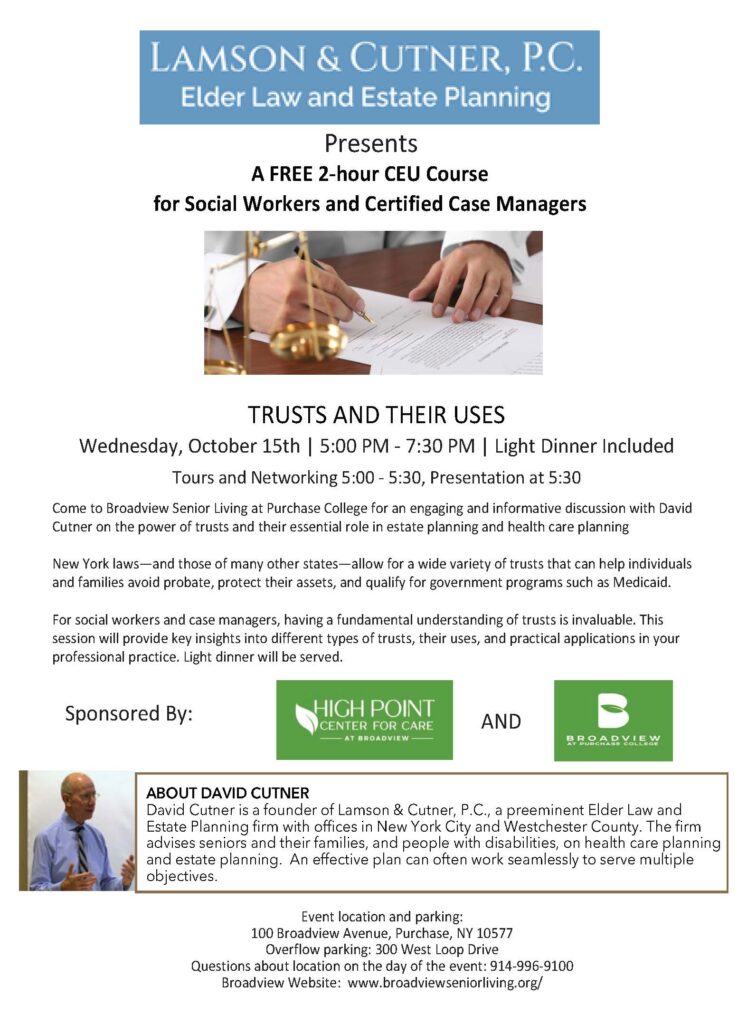
Register for Oct 15 CEU Course at Broadview Senior Living
Plan-a-Palooza 2025 - Saturday, September 27
10:00 am - 12:30 pm (Doors open at 9:45)
Rye Presbyterian Church*, 882 Boston Post Road, Rye NY 10580
*The event is not affiliated with the church
Need to review the flyer with all the info? Click here
We're sorry, the event has been postponed. We are actively working on rescheduling it and will let everyone know once we have a new date. Thank you!
May is Older Americans Awareness Month:
The Revolution in Longevity Has Created Opportunities and Risks
You may be older than you used to be, but you’re still the person you always were. That’s a message younger people need to learn. A 70-, 75- or 80-year-old person, whether robust and fit, or even if compromised in some way, is often still active and fully involved in living – an individual, not a geriatric leftover.
Getting older doesn’t have to be all aches and pains. In fact, studies have shown that older people are happier than those in the middle period of their lives, even if they have health or other issues.
Years ago, people didn’t realize that they could lengthen their active years, sometimes by decades, by taking steps to maintain their mental and physical health. In recent years, science has shown that diet, exercise, community connection, good sleep habits, and a sense of purpose can improve people’s health and mental faculties, and often dramatically lengthen their lives.
Medicines and medical equipment have also extended lives. Heart disease is being fought on many fronts, as is cancer in all its forms. Joint replacements and diabetes management have involved high tech medical equipment that has been miraculous for millions.
Physical changes do come with the passing of time, but again, people have learned to take preventive measures to limit or postpone the risks and negative effects. Learning about fall prevention, balance and strength exercises, protecting skin against sun damage, and wearing sunglasses to prevent cataracts are all actions people have learned to take, to help them avoid problems and continue to enjoy their lives.
One of the challenges people face when they live far longer than they used to, is that they may need care and assistance in their homes or in a residential facility for a decade or more. They can still live satisfying lives, but they need assistance with some of their activities. With families far more spread out than was the case decades ago, this care is often provided by paid caregivers.
People who begin needing care often don’t realize until well into their assistance-needing period, that caregiving can be a disastrous drain on their finances. Caregivers aren’t getting rich, but they need to be paid, and home health companies have both legwork and paperwork for which they need to be compensated.
The combination of these factors means that costs can skyrocket, and the net result of paying for care is often that people’s entire life savings are wiped out. People try to reduce the cost of care by paying their caregivers in cash. Not only is this illegal, it exposes the employer to enormous liability, should the caregiver be injured on the job.
The attorneys at Lamson & Cutner feel it is crucial for older people, and the children or loved ones of those older people, to be informed. Learning about the financial risks of long-term care costs, and about the opportunities that are available to protect them against these risks, will enable those who need long-term care to maintain their lifestyles to the greatest extent possible.
Our firm spends a lot of time and energy on educating people about issues surrounding long-term care. We have worked to make our website informative, understandable and useful. In addition, we have a very busy speaking schedule. We are authorized to give CEU credits to health care professionals and social workers. We also give general-interest presentations at senior centers, houses of worship, and other venues, to people who might face long-term care costs for themselves or others.
Becoming informed – and taking action – are your best defenses against both the physical and financial risks that come with age. You’re never too old to start. Learn, act, and live your best life!
New York’s Consumer Directed Personal Aid Program (“CDPAP”):
Huge Changes are Arriving NOW
New York's CDPAP program allows a person who is eligible for NY Medicaid home care, or their designated representative, to select, hire, train and schedule their own caregivers. The caregiver can be a friend or family member other than a spouse. An MLTC (Managed Long Term Care) plan determines how many hours of care will be granted. The disabled person or their representative is the employer, and they are responsible for arranging their own back-up coverage.
Until the end of this month, about 600 Fiscal Intermediaries (“FIs”) handle payroll, time sheets and benefits under a contract with an MLTC plan or local Medicaid agency.
CDPAP allows more flexibility than traditional personal care:
The CDPAP Personal Aide (“CDPAP PA”) can administer meds, for example, put a pill in the consumer’s mouth, inject insulin, manage home dialysis, and more. A Home Health Aide or Personal Care Aide is not permitted to perform these tasks – their job is primarily to assist with Activities of Daily Living.
The CDPAP PA is trained by the consumer or their representative – no formal training is required. With traditional personal care, Home Health Aides and Personal Care Aides are required to have training and certification.
With CDPAP, family members other than the spouse may be hired as a CDPAP PA, whereas with traditional personal care, the rules about which family members can be hired are more restrictive.
Right now:
Over 600 Fiscal Intermediaries in NY (both for-profit and non-profit companies) administer CDPAP.
Each MLTC or Medicaid managed care plan has a Provider Network of FIs; CDPAP participants must use one of the FIs in their plan’s network
Fiscal Intermediary differences are in the amount of wages and benefits paid, support provided, and Electronic Visit Verification systems.
A Huge Change is Coming on March 28
New York selected one company located in Georgia, called PPL, to replace the over 600 current CDPAP Fiscal Intermediaries. All MLTC plans, other managed care plans, and Medicaid agencies must sign a contract with PPL. 37 of the current NY Fiscal Intermediaries have been selected as “facilitators” with a limited role: customer service, transition assistance, and visitation verification support.
What does this mean?
Every current Fiscal Intermediary will no longer be able to offer CDPAP services. Many FIs also offer personal care as a Licensed Home Care Services Agency, but as shown before, these services are far more restricted. All FIs who do not offer licensed home care services will likely go out of business.
By March 28, all CDPAP consumers (of which there are about 250,000) and Personal Assistants (about 500,000) will need to register and transition their services to PPL.
Unless the consumer and the CDPAP PAs register with PPL, the consumer will lose CDPAP services.
Many changes will or may occur – wages may drop, overtime could be affected, documentation of care will change, and some CDPAP PAs may not successfully transition to become employees of PPL. Any of these changes may negatively affect the care that people receive. As the sole payer and administrator of CDPAP employees, PPL could be pressured to keep wages low or introduce other restrictions.
A CDPAP PA may switch to traditional personal care (if permitted by the family rules), but will need to be trained, will not be able to administer meds or perform many other “skilled tasks,” and will become an employee of the Licensed Home Care Service Agency – so they could be assigned to another consumer. The consumer is no longer in control.
The rollout is already proving to be chaotic and messy. There have been reports of unreturned phone calls to PPL and poor customer service. The change will cause disruption to many thousands of people who receive care, and to their caregivers.
What Should You Do?
If you are using CDPAP services and have not yet begun the transition process: START NOW. As of March 3, there were still 150,000 consumers and 400,000 workers who had not begun the transition process – and it takes weeks to complete! Workers will not be paid for work done after April 1 if the consumer and the worker did not complete the registration – and (for the moment) there is NO backup plan for people still in the pipeline. Don’t lose your services – act now.
The patient or family needs to initiate the transition to PPL:
Confirm if your current home health agency is a CDPAP Facilitator. If they are not, choose from the list of CDPAP facilitators (link is also below) and contact them to start the transition over to a new agency.
If you have any registration questions, call the customer support line for PPL at 833-247-5346. Be persistent - as noted above, there have been reports of numerous unreturned phone calls.
Both the consumer and the CDPAP PA can create online profiles using the link to register (link also shown below). The transition can be done through the created account.
Facilitators have been very helpful with helping people to set up accounts – do not hesitate to call them for assistance!
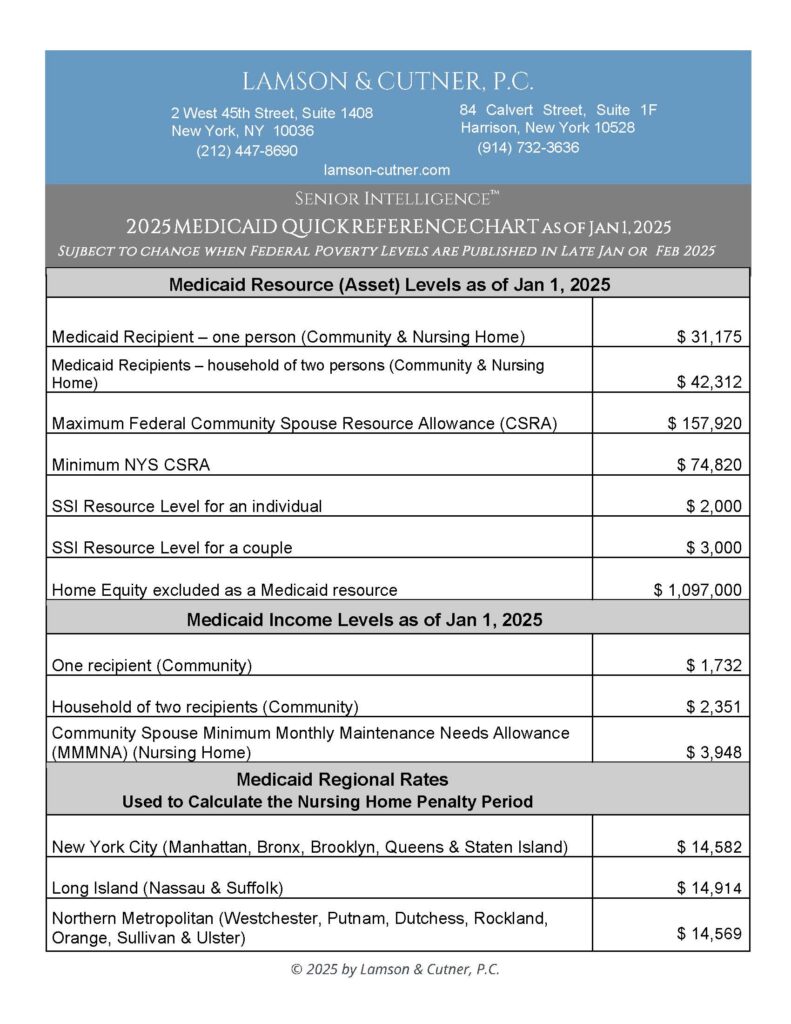
NY State has published 2025 Medicaid threshold levels and nursing home Regional Rates: Some will change when new Federal Poverty Levels are announced
The New York Medicaid limits and thresholds for 2025 have been published - but they will probably change in February. The NY Medicaid eligibility limits for income and "resources" (assets) are tied to the Federal Poverty Level ("FPL"). That figure is normally published by the Federal Government in February, so when that happens, NY Medicaid levels will be adjusted to account for changes in the FPL. Nursing Home "Regional Rates," used to calculate the nursing home Penalty Period, have now also been published. Regional Rates will probably not change.
Below is our currently-valid 2025 Medicaid Quick Reference Chart. It shows useful information regarding the limits imposed on income and resources for people who are applying for (or renewing) Medicaid coverage. The chart can also be found on our website here.
A Shocking Surprise Regarding Urgent Care Facilities
A recent article in the New York Times, written by a doctor, revealed that different urgent care facilities sometimes charge wildly different prices, based on their status. The doctor’s daughter needed an x-ray, and the urgent care billed them for hospital-based x-rays. The doctor, who works in a hospital, was expecting a bill of around $200, but instead she received a bill for $1,168.
[Here is a link to the article. It is a “gifted” article so there should be no paywall.]
The doctor discovered that some urgent care facilities are hospital-affiliated, and are deemed to be “hospital outpatient departments,” or HOPDs. The article states, “there is no federal protection for patients who are unknowingly treated in higher-priced hospital affiliates that look like normal doctors’ offices or urgent care clinics.” In other words, nobody at the urgent care is required to tell you that they may charge you far more than the non-hospital-affiliated urgent care facility down the street.
A study by the National Institute for Health Care Reform (NIHCR) found that “Average hospital outpatient department prices for common imaging, colonoscopy and laboratory services can be double the price or more for identical services provided in a physician’s office or other community-based setting.” The study found that prices vary across and within local markets.
Hospitals, and the American Hospital Association, have attempted to justify these costs by claiming that HOPDs treat patients who are sicker. But often, regardless of the patient's health situation, the procedure is identical. A broken ankle x-ray is the same no matter who gets it or where it is performed. In addition, when someone needs urgent care, one clinic looks the same as the next. Charging a different price appears to have far more to do with a profit motive than the health status of the patient.
In recent years, hospitals have been acquiring physicans’ practices. In the case of urgent care clinics, this allows them to change the designation of what was formerly a community-based facility into an HOPD. Insurers often cover the same amount for a procedure regardless of where it is performed. The result is that a large bill for the amount over the covered cost often ends up falling on the patient who unwittingly used an HOPD. If the bills from your local urgent care provider have skyrocketed recently, you may be a victim of this status change.
Even more surprising to me, is that the NIHCR study about higher costs in HOPDs was published in 2014. I had never heard of this secret dichotomy before I read the NYT article. I called the walk-in clinic associated with the medical practice I usually use, and was told that yes, they are an HOPD. That would probably explain the egregious $300+ cost of a recent 10-minute visit to examine a large rash that surrounded a bug bite I received (Lyme test, extra cost, negative).
I checked several of the urgent care facilities in my area and their websites said nothing about their HOPD status. If you are using an urgent care facility, or might need to, it would make sense to call several, and if you can get through to a human being (not often an easy task), ask them. Finding an urgent care that is NOT billing as a Hospital Outpatient Department could save you thousands of dollars over time, or even in one visit.
New Hurdles Imposed for Medicaid Applicants in New York State
New York state recently enacted legislation, and declined to moderate existing legislation, that makes accessing the state’s Medicaid program more difficult and complicated.
I. The Consumer Directed Personal Assistance Program (“CDPAP”) will undergo major changes.
Currently over 600 companies act as Fiscal Intermediaries (FIs) for the CDPAP program. These FIs assist people who hire Personal Assistants (“PAs”) through the CDPAP program, by handling payroll and benefits. FIs sometimes also help consumers find and train Personal Assistants. These intermediaries are often small, local companies. FIs are under contract with, and are paid by, Medicaid Long Term Care (“MLTC”) plans, mainstream managed care plans, and local Departments of Social Services that authorize CDPAP services.
Now the NYS Department of Health will be required to contract with a single Fiscal Intermediary – and that intermediary must already be operating in another state as a statewide FI. That single FI will subcontract with a small number of existing FI programs. By April 1, 2025, all 200,000 CDPAP consumers and their PAs will be transitioned to the new SINGLE FI or one of their few subcontractors, and ALL other FIs must stop operating.
That means that whichever FI is chosen, and its few subcontractors, are likely not to have a local presence in many of the parts of the state, and consumers who hire Personal Assistants will be dealing with a huge corporation rather than a small, responsive service provider. This will eliminate almost all choice, as well as competition, from the current 600 providers.
II. CDPAP Personal Assistants may have new training requirements
The new law authorizes the Department of Health to adopt regulations “to carry out the objectives of the program including … training requirements for PAs.” Currently, the consumer or their representative trains the PAs, and no outside training is required. CDPAP PAs are then able to perform numerous critical tasks that long-term care aides are not permitted to perform. These tasks include assisting patients with taking medications, injecting insulin, administering oxygen, and other duties that would otherwise require the costly services of a nurse.
If additional training is required, this obligation will discourage potential candidates from becoming PAs. These important workers are already in short supply: fewer PAs will mean it will take longer – or it might be impossible – to find an assistant.
III. Cuts to Medicaid that are still scheduled to occur:
30-Month Look back for Community Medicaid Services
The 30-month “look back” and transfer penalty for Community Medicaid services, which was enacted but which was delayed due to COVID, was not repealed. This measure is scheduled to be implemented in 2025. Implementation will delay or effectively deny home care services that are crucial to enable people to remain in their homes as long as possible.
This complicated change will be a nightmare to implement. The look back will impose a penalty period for transfers made in the 30 months prior to a person applying for Community Medicaid services (these services include paying for some Assisted Living residences). There is currently no look back.
Three ADL Requirement
Currently, disabled people who require assistance with two Activities of Daily Living (“ADLs”) qualify for Community Medicaid services (if financial eligibility is achieved). Implementation of this measure will require that people need assistance with three ADLs before they are eligible.
This increased requirement will make it far more difficult for seniors in declining health to access Medicaid services. In addition, the New York Legal Assistance Group states that this “will deny Medicaid home care illegally to Those With Vision Impairments, Intellectual & Developmental disabilities, Traumatic Brain Injuries, and many other disabilities.” This requirement will go into effect in Fall 2024 if not repealed.
The New York State Bar Association, New York Legal Assistance Group, and the National Association of Elder Law Attorneys are all fighting to repeal this harmful legislation. Our firm will support their efforts.
Ongoing changes to New York State’s long-term care regulations mean that it is more important than ever for anyone over 65, or earlier if you have health issues, to consult with an experienced Elder Law attorney. The sooner you take action, the more long-term care planning can help you. During a consultation with our firm, our attorney will explore your situation, thoroughly explain your options, and enable you to decide for yourself what plan makes the most sense for you.
The most effective planning occurs before you have a need for long-term care, but planning can still have enormous benefits even if undertaken later. Don’t hesitate to call – a consultation will provide you with important information and can give you priceless peace of mind.